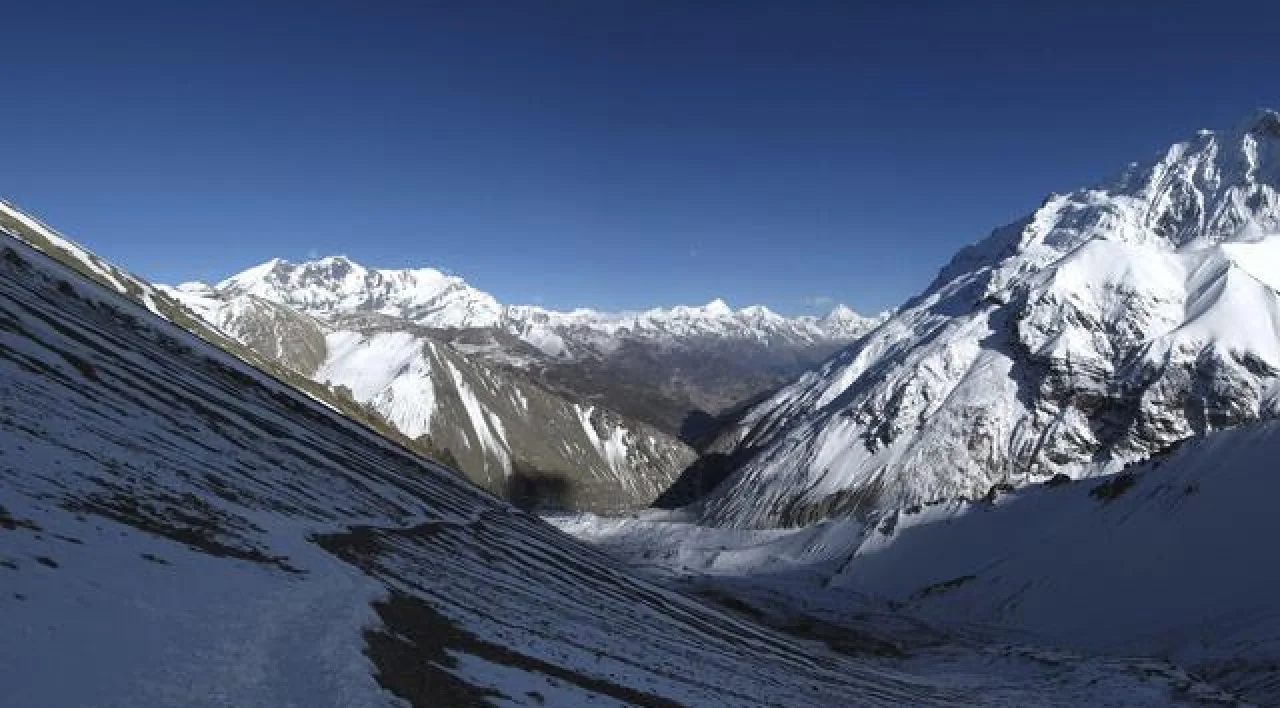
Pisang Peak Climbing with Trail Mania Trek is an unforgettable Himalayan adventure combining Annapurna Circuit trekking with a challenging 6,091m summit. Experience spectacular mountain views, acclimatization, climbing preparation, Manang Valley, Thorong La Pass, Muktinath, and authentic Himalayan culture throughout this remarkable journey.
Hotel in Kathmandu / Pokhara and Tea House / Lodge / Camp during the trek
Pisang Peak Climbing is an exciting Himalayan adventure that combines the famous Annapurna Circuit trekking experience with the challenge of climbing a 6,091-meter (19,985-foot) Himalayan peak. Organized by Trail Mania Trek, this 18-day journey begins in Kathmandu and follows the scenic route through Jagat, Dharapani, Chame, and Upper Pisang before reaching Pisang Peak Base Camp. The itinerary is designed to provide gradual altitude gain, preparation, acclimatization, and a dedicated summit attempt.
The journey offers a remarkable variety of landscapes, from green valleys and forests to high-altitude alpine terrain, while also providing opportunities to experience traditional Himalayan villages and local culture. After the summit attempt, the adventure continues toward Manang, Yak Kharka, Thorong Phedi, and the spectacular Thorong La Pass at 5,416 meters. The trek then descends toward Muktinath and Jomsom before flying to Pokhara and returning to Kathmandu.
A major advantage of this itinerary is that climbers receive both preparation and acclimatization days in Upper Pisang before approaching the mountain. The training day allows the climbing team to prepare equipment and review essential techniques, while the acclimatization day helps the body adjust to the increasing elevation.
For adventurous travelers, Pisang Peak provides an excellent opportunity to experience Himalayan peak climbing without making the expedition entirely separate from a classic trekking route. The combination of mountaineering, high-altitude trekking, cultural encounters, and spectacular mountain scenery makes this a memorable adventure with Trail Mania Trek.
The best seasons for Pisang Peak Climbing are generally spring (March to May) and autumn (September to November). These months are favored because the weather in the Himalayas is usually more stable, mountain visibility is often excellent, and trekking conditions are generally more comfortable. Spring brings pleasant conditions at lower elevations and beautiful blooming vegetation, while autumn commonly provides crisp skies and impressive views of the surrounding Annapurna peaks.
Weather conditions become increasingly important as the itinerary moves above 4,000 meters. The summit section at 6,091 meters can involve freezing temperatures, strong winds, snow, and rapidly changing conditions. Trail Mania Trek includes a contingency day in the itinerary, giving the climbing team some flexibility if weather or mountain conditions make the planned summit day unsuitable.
Although spring and autumn are considered the most suitable periods, Himalayan weather can never be guaranteed. Conditions should be evaluated locally before the summit attempt, and the climbing leader's judgment should take priority over a fixed schedule.
Trail Mania Trek can help travelers select a suitable departure period according to their climbing experience, schedule, and preferred conditions. Choosing an appropriate season can improve trekking comfort and mountain visibility while increasing the possibility of having favorable conditions for the summit attempt.
Pisang Peak Climbing is a challenging high-altitude adventure that requires good physical fitness, endurance, and mental preparation. The summit reaches 6,091 meters, and climbers must cope with low oxygen levels, cold temperatures, steep terrain, snow, and potentially unpredictable mountain weather. Previous experience with high-altitude trekking is strongly beneficial, while basic mountaineering knowledge can make the climbing experience more manageable.
The itinerary allows time for preparation and acclimatization before the summit. After reaching Upper Pisang, climbers have a preparation and training day followed by an acclimatization day. The route then progresses to Base Camp at 4,380 meters and High Camp at 5,400 meters before the summit attempt. Depending on conditions, climbing equipment and techniques may include crampons, ropes, harnesses, ice axe use, and other mountaineering equipment.
Transportation is an important part of the overall expedition. The adventure begins with a road journey from Kathmandu to Jagat, after which most of the journey is completed on foot. The trekking route passes through Dharapani, Chame, Upper Pisang, Pisang Peak Base Camp, Manang, Yak Kharka, and Thorong Phedi.
After crossing Thorong La Pass, the itinerary continues to Muktinath and Jomsom. From Jomsom, travelers fly to Pokhara and then travel by road from Pokhara to Kathmandu. Road and flight operations in mountainous regions can sometimes be affected by weather or local conditions, so flexibility is important. Trail Mania Trek coordinates the transportation arrangements according to the itinerary and prevailing conditions.
Food and accommodation play an important role in maintaining energy and recovering properly during a demanding high-altitude expedition. During the trekking sections of the journey, accommodation is generally provided in local teahouses or mountain lodges. These establishments offer basic but comfortable facilities, allowing trekkers to rest after long days on the trail.
Meals along the Annapurna route commonly include traditional Nepali food as well as several familiar international dishes. Dal bhat, rice, lentils, vegetables, noodles, pasta, potatoes, soups, eggs, bread, and other locally available foods are common choices. Since higher-altitude settlements are more remote, food variety may become more limited as the trek approaches Base Camp and High Camp.
At Pisang Peak Base Camp and High Camp, facilities are considerably more basic than in the lower villages. Climbers should be prepared for cold nights, limited washing facilities, and simple sleeping arrangements. A good-quality sleeping bag and appropriate high-altitude clothing are essential for maintaining warmth and comfort.
Trail Mania Trek can also assist with meal and accommodation arrangements throughout the expedition. Climbers should inform the company about dietary requirements before departure. Maintaining regular meals and adequate hydration is particularly important at altitude, where the body uses significant energy even when appetite may decrease.
Pisang Peak Climbing requires appropriate permits and official documentation because the journey involves climbing a recognized Himalayan peak and trekking through the Annapurna region. The required documentation may include the Pisang Peak climbing permit, Annapurna Conservation Area documentation, and other applicable trekking or local registrations. Trail Mania Trek assists clients with the necessary permit arrangements as part of the expedition preparation.
Permit requirements, fees, and regulations can change according to government policies, season, and other official considerations. Therefore, climbers should obtain current information before departure rather than relying on outdated permit details. Trail Mania Trek can help ensure that the required documentation is prepared according to the regulations applicable to the planned climbing season.
Carrying the correct documentation throughout the trek is important because permits may be checked at different points along the route. Climbers should also follow conservation-area rules and respect local communities, cultural traditions, and environmental guidelines.
Proper permitting contributes to responsible and regulated tourism in the Annapurna region. By arranging permits and expedition logistics in advance, Trail Mania Trek helps climbers avoid unnecessary administrative difficulties and concentrate on preparation, trekking, acclimatization, and the summit objective.
Choosing Trail Mania Trek for Pisang Peak Climbing provides an opportunity to experience a challenging Himalayan summit while following a comprehensive itinerary through the Annapurna region. The 18-day program is structured with preparation, training, acclimatization, a summit attempt, and a contingency day. This gradual approach is important for adapting to altitude and preparing for the demanding conditions encountered above 5,000 meters.
The adventure is also much more than a peak-climbing expedition. The route combines Pisang Peak with some of the most impressive sections of the Annapurna Circuit, including Manang Valley and Thorong La Pass. Travelers can experience dramatic mountain landscapes, traditional villages, Buddhist cultural influences, alpine scenery, and the contrasting environments found on both sides of the Annapurna range.
Trail Mania Trek focuses on organizing the practical elements of the journey, including transportation, accommodation, meals, permits, route planning, and climbing logistics. The preparation day in Upper Pisang provides an opportunity to review equipment and climbing procedures before entering the higher mountain environment.
Ultimately, Pisang Peak Climbing with Trail Mania Trek is an ideal choice for adventurous travelers seeking a combination of Himalayan trekking and mountaineering. With proper preparation, suitable equipment, realistic expectations, appropriate acclimatization, and professional guidance, the journey offers the opportunity to reach a 6,091-meter summit while experiencing the spectacular landscapes and culture of the Annapurna region.
Upon your arrival in Kathmandu, the team from Trail Mania Trek will warmly welcome you at Tribhuvan International Airport and transfer you to your hotel. After check-in, you can take some time to rest and recover from your journey. Depending on your arrival time, you may explore the nearby streets of Thamel or simply relax at the hotel. In the evening, your climbing guide will meet you for a detailed briefing about the Pisang Peak climbing itinerary, required equipment, safety procedures, and trekking conditions. Overnight at a hotel in Kathmandu.
After an early breakfast, you begin the scenic drive from Kathmandu toward Jagat, the starting point of your trekking adventure. The journey follows winding mountain roads alongside the Trishuli River and gradually enters the beautiful landscapes of the Annapurna region. You will pass through colorful villages, terraced farmland, lush hills, and river valleys before reaching Jagat. Although the drive is long, it provides an excellent introduction to rural Nepal and the dramatic Himalayan environment. Your Trail Mania Trek team will arrange transportation and assist throughout the journey. Overnight at a local teahouse in Jagat.
Today marks the beginning of your trek through the spectacular Annapurna region. After breakfast, you follow the trail from Jagat toward Dharapani, passing through beautiful villages, waterfalls, forests, and steep river valleys. The trail gradually gains elevation as you move deeper into the mountains. Along the way, you will encounter traditional settlements and experience the unique culture of the local communities. The changing landscape, from subtropical vegetation to cooler mountain forests, makes this a rewarding day of trekking. Your guide from Trail Mania Trek will maintain a comfortable pace to help you adapt gradually to the increasing altitude. Overnight at a teahouse in Dharapani.
The trail continues from Dharapani toward Chame, the administrative center of Manang District. As you gain altitude, the landscape becomes increasingly mountainous, with pine and fir forests surrounding the trail. Along the way, you will enjoy impressive views of Annapurna II, Lamjung Himal, and other snow-covered peaks. The trail crosses several streams and passes through small mountain settlements before reaching Chame. After arrival, you can explore the village and enjoy the surrounding Himalayan scenery. This stage is also important for gradual acclimatization before approaching Pisang Peak. Overnight at a teahouse in Chame.
After breakfast, you leave Chame and continue toward Upper Pisang. The trail passes through dense pine forests and follows the Marsyangdi River, with spectacular views of the Annapurna mountain range becoming increasingly prominent. As you approach Pisang, the environment becomes drier and more alpine, reflecting the rain-shadow landscape of the Manang Valley. Upper Pisang is a beautiful traditional settlement surrounded by dramatic peaks and ancient Buddhist cultural features. You will have time to settle into your teahouse and rest after the trek. Your guide will also monitor your condition carefully as you prepare for the higher elevations ahead. Overnight at Upper Pisang.
Today is dedicated to preparation and practical climbing training in Upper Pisang. Under the supervision of your experienced Trail Mania Trek climbing guide, you will review the techniques and procedures necessary for Pisang Peak. Training may include the proper use of crampons, harnesses, climbing ropes, ice axe, ascender, descender, and other essential mountaineering equipment. Your guide will also explain rope-management techniques, movement on snow and ice, and basic safety procedures. The day allows you to become comfortable with your equipment while remaining at a suitable altitude. It is an important preparation stage before moving toward the peak's base camp and higher elevations.
A dedicated acclimatization day in Upper Pisang helps your body adjust to the reduced oxygen levels before you ascend higher toward Pisang Peak. Rather than remaining completely inactive, you will take a short acclimatization hike around the surrounding hills and viewpoints before returning to Upper Pisang. You can enjoy magnificent views of Annapurna II, Annapurna IV, Pisang Peak, and the surrounding Himalayan landscapes. Your climbing guide will monitor your health and provide recommendations regarding hydration, nutrition, rest, and altitude awareness. This additional day is valuable for improving your chances of making a safe and successful summit attempt.
Today you leave Upper Pisang and begin ascending toward Pisang Peak Base Camp. The trail gradually moves through increasingly rugged alpine terrain, with vegetation becoming sparse as the elevation rises. You will trek through a spectacular mountain environment surrounded by rocky slopes, glaciers, and towering Himalayan peaks. The journey is shorter than some previous trekking days, but the increasing altitude makes the walk physically demanding. Upon reaching base camp, the climbing team will establish camp and prepare for the upcoming ascent. Your guide will inspect equipment, review the climbing plan, and ensure everything is ready for the high-altitude stages. Overnight at Pisang Peak Base Camp.
After breakfast, you begin the challenging ascent from Pisang Peak Base Camp toward High Camp. The terrain becomes steeper and more technical as you move onto rocky and potentially snow-covered slopes. Depending on current conditions, ropes and other climbing equipment may be used to ensure safe movement. The pace will be deliberately slow to conserve energy and allow your body to adjust to the increasing altitude. Once at High Camp, your climbing team will prepare the camp and organize equipment for the summit attempt. Your guide will provide a final briefing covering the route, weather, timing, climbing techniques, and emergency procedures. Overnight at High Camp.
This is the major highlight of your expedition: the summit attempt on Pisang Peak. You will begin very early, generally before sunrise, to take advantage of stable morning conditions and maximize available daylight. Under the guidance of your experienced climbing team, you ascend carefully across steep and challenging terrain toward the summit. From the top at 6,091 meters, you can enjoy spectacular panoramic views of Annapurna II, Annapurna III, Annapurna IV, Manaslu, Tilicho Peak, and numerous surrounding Himalayan mountains. After spending a safe amount of time at the summit, you descend carefully to High Camp and continue toward Base Camp. Overnight at Base Camp.
A contingency day is reserved to provide flexibility for the Pisang Peak summit attempt. Himalayan weather can change rapidly, and strong winds, snowfall, poor visibility, or unfavorable climbing conditions may make a summit attempt unsafe on the scheduled day. If necessary, your Trail Mania Trek climbing team can use this day for another summit attempt or additional time at a suitable location. If the summit has already been successfully completed, the day can be used for additional rest and recovery before continuing toward the Manang Valley. The final decision regarding climbing conditions will always be made with safety as the highest priority.
After completing the climbing section, you descend from Pisang Peak Base Camp toward the beautiful Manang Valley. The change in altitude provides welcome relief after spending time above 5,000 meters. The trail passes through rugged mountain landscapes, traditional villages, Buddhist monasteries, and impressive views of the Annapurna range. As you approach Manang, the valley becomes broader and the scenery takes on a distinctive high-altitude character. Once in Manang, you can enjoy a well-deserved rest, explore the village, and experience the local Himalayan culture. Overnight at a teahouse in Manang.
Today you continue your journey toward the Thorong La region, trekking from Manang to Yak Kharka. The trail gradually climbs through an increasingly barren alpine environment where trees become scarce and mountain vegetation becomes low and sparse. Along the way, you may see yak and other Himalayan animals grazing on the surrounding slopes. The route offers excellent views of Annapurna III, Gangapurna, and other spectacular peaks. Although the trekking distance is relatively short, the elevation makes it important to maintain a slow, steady pace. Your Trail Mania Trek guide will continue monitoring everyone for signs of altitude-related difficulties. Overnight at Yak Kharka.
After breakfast, you continue from Yak Kharka to Thorong Phedi, the final major settlement before crossing the famous Thorong La Pass. The trail follows a dramatic high-altitude landscape with steep mountain walls, barren slopes, and expansive views of the surrounding peaks. You will cross several sections of rugged terrain while gradually gaining elevation. Thorong Phedi serves as an important resting point before the demanding pass-crossing day. Upon arrival, you will have time to rest, hydrate, organize your belongings, and prepare your clothing and equipment for the early start tomorrow. Your guide will provide a briefing about the pass crossing and weather conditions. Overnight at Thorong Phedi.
Today is one of the longest and most challenging days of the trek as you cross Thorong La Pass, one of the highest trekking passes in the world. You will start very early and gradually climb through the rugged mountain terrain toward the pass. After reaching 5,416 meters, you can enjoy magnificent views of the surrounding Himalayan landscape before beginning the long descent toward Muktinath. Muktinath is an important pilgrimage destination with deep religious significance for both Hindus and Buddhists. From Muktinath, you continue toward Jomsom, where the lower elevation provides a significant change in climate and scenery. Overnight in Jomsom.
After breakfast, you take a scenic flight from Jomsom to Pokhara, offering a spectacular aerial perspective of the mountains and Kali Gandaki Valley when weather conditions permit. The short flight provides a dramatic transition from the high Himalayan environment to the much warmer and greener surroundings of Pokhara. After arriving in Pokhara, you will transfer to your hotel and have the remainder of the day to rest and relax. You may also explore the lakeside area, enjoy views of Phewa Lake, or simply recover after the demanding climbing and trekking journey. Overnight at a hotel in Pokhara.
Today you return to Kathmandu by road. The journey follows scenic highways through green hills, river valleys, terraced farmland, and traditional settlements. It provides an opportunity to reflect on your Pisang Peak climbing adventure while traveling back toward Nepal's capital. Depending on road and traffic conditions, the journey may take several hours. After arriving in Kathmandu, you will check into your hotel and have free time to relax or explore the city. You can also use this opportunity for last-minute shopping, souvenir collection, or enjoying a farewell dinner with your Trail Mania Trek team. Overnight at a hotel in Kathmandu.
Your memorable Pisang Peak climbing adventure with Trail Mania Trek comes to an end today. Depending on your flight schedule, you will have some free time in Kathmandu for shopping or relaxing before your airport transfer. A representative from Trail Mania Trek will assist you with your transfer to Tribhuvan International Airport in time for your international departure. As you leave Nepal, you take home unforgettable memories of the Annapurna region, challenging high-altitude trekking, Himalayan landscapes, and the achievement of attempting or summiting Pisang Peak. We hope to welcome you again for another Himalayan adventure in the future. Safe travels and farewell!
Your Start Date is the day you land in Nepal, and your End Date is when you fly home.
If the set Pisang Peak Climbing group dates don’t suit your schedule, we can offer alternative dates upon request.
Pisang Peak Climbing is an exciting Himalayan mountaineering adventure that combines the classic Annapurna Circuit trekking experience with the ascent of Pisang Peak at 6,091 meters. With Trail Mania Trek, the journey is carefully organized to include trekking, acclimatization, climbing preparation, technical training, experienced guides, and a dedicated summit attempt. The adventure takes you through beautiful mountain villages, alpine landscapes, and high-altitude terrain while providing an opportunity to experience a challenging yet rewarding Himalayan peak.
Pisang Peak is considered a challenging trekking peak because the expedition involves both long-distance trekking and sections of technical climbing at high altitude. Climbers should be comfortable walking for several hours a day on steep and uneven mountain trails and should have good physical endurance. Depending on conditions, the climbing section may require crampons, an ice axe, ropes, harnesses, and other mountaineering equipment. Trail Mania Trek provides climbing guidance and practical training to help participants understand the techniques and safety procedures required for the ascent.
Previous mountaineering experience is highly recommended, although experienced trekking participants with good fitness can also prepare for the climb with proper guidance and training. Pisang Peak should not be approached as an ordinary trekking route because the summit involves high altitude and potentially technical terrain. Trail Mania Trek provides a preparation and training day where climbers can learn or refresh essential skills such as using crampons, harnesses, ropes, an ice axe, an ascender, and other climbing equipment. Proper preparation significantly improves confidence and safety during the summit attempt.
Pisang Peak rises to approximately 6,091 meters (19,985 feet) above sea level, making it a significant high-altitude climbing objective in the Annapurna region. Reaching this elevation requires gradual acclimatization because the amount of available oxygen is considerably lower than at lower elevations. The itinerary organized by Trail Mania Trek includes acclimatization and preparation days before the summit attempt. Climbers gradually move from the lower trekking areas toward Base Camp and High Camp, allowing their bodies time to adapt to the increasing altitude.
The itinerary presented by Trail Mania Trek takes 18 days, beginning with arrival in Kathmandu and ending with international departure. The program includes the drive to the Annapurna region, trekking to Upper Pisang, climbing preparation, acclimatization, the approach to Pisang Peak Base Camp and High Camp, the summit attempt, a contingency day, and the continuation of the trek toward Thorong La Pass. The journey then finishes with travel through Jomsom and Pokhara before returning to Kathmandu. The schedule is designed to combine climbing and trekking while allowing time for acclimatization.
Trail Mania Trek includes a dedicated preparation and training day in Upper Pisang before the climbing portion begins. During this session, your climbing guide can explain and demonstrate the proper use of important mountaineering equipment, including crampons, harnesses, ropes, ice axe, ascender, and descender. You may also practice basic climbing techniques and rope-management procedures according to the conditions and needs of the group. The training is particularly useful for climbers who need to refresh their technical skills before entering the higher and more demanding sections of the Pisang Peak route.
Altitude acclimatization is an important part of the Pisang Peak program, and Trail Mania Trek structures the itinerary with gradual elevation gain and dedicated acclimatization periods. The program includes preparation and acclimatization in Upper Pisang before moving toward Base Camp and High Camp. Guides monitor climbers for symptoms associated with altitude and encourage appropriate pacing, hydration, nutrition, and rest. Because individual responses to altitude differ, the itinerary can be adjusted when necessary. Climbers are encouraged to communicate openly with their guide whenever they experience unusual symptoms or difficulty at elevation.
After a successful summit of Pisang Peak, you descend carefully from the higher elevations and return toward Base Camp before continuing into the Manang Valley. The descent provides an opportunity to recover after the demanding summit day while enjoying the changing Himalayan scenery. The itinerary then continues through Manang, Yak Kharka, Thorong Phedi, and across Thorong La Pass before descending toward Muktinath and Jomsom. With Trail Mania Trek, the climbing adventure therefore forms part of a broader Himalayan journey that combines the Pisang Peak ascent with an extended trek through the Annapurna region.
The best seasons for Pisang Peak Climbing are generally spring and autumn because these periods usually offer more favorable mountain conditions, clearer views, and comparatively stable weather. Spring typically provides beautiful mountain scenery and pleasant trekking conditions, while autumn is well known for clear skies following the monsoon season. However, conditions at high altitude can change rapidly at any time. Trail Mania Trek monitors the itinerary and climbing conditions carefully and may adjust the summit schedule when necessary to prioritize safety.
Mountain weather can be unpredictable, particularly around high-altitude climbing areas, so a summit attempt may occasionally need to be postponed for safety reasons. The Trail Mania Trek itinerary includes a contingency day specifically to provide flexibility for unfavorable weather or other unexpected conditions. Your climbing guide will assess factors such as wind, snowfall, visibility, route conditions, and the overall safety of the ascent before making a decision. If conditions are unsafe, the team will prioritize a safe alternative rather than taking unnecessary risks simply to maintain the original schedule.
Pisang Peak is a permitted Himalayan climbing peak, so climbers need the appropriate climbing and trekking permits for the expedition. The exact permit requirements, fees, and administrative procedures can vary depending on current Nepal government regulations and the season. Trail Mania Trek can assist with arranging the required permits and coordinating the necessary documentation before the expedition begins. Climbers should provide accurate passport information and other requested documents during the booking process so that the permit arrangements can be completed properly and without unnecessary delays.
Accommodation varies according to the section of the itinerary. During the lower-altitude trekking stages, you will generally stay in local teahouses or lodges offering basic but comfortable facilities. In places such as Upper Pisang, Manang, Yak Kharka, Thorong Phedi, and Jomsom, accommodation is typically based on locally operated mountain lodges. During the climbing section, accommodation changes to camping at Base Camp and High Camp. Trail Mania Trek organizes the necessary camping arrangements and support for the climbing portion while helping coordinate teahouse accommodation along the trekking route.
During the trekking portion, teahouses generally offer a variety of meals designed to provide energy for long walking days. Common options may include rice, noodles, soup, pasta, potatoes, vegetables, eggs, bread, and traditional Nepali meals. At higher elevations, food choices can become more limited. Staying properly hydrated is especially important during high-altitude trekking and climbing. Trail Mania Trek recommends drinking sufficient water throughout the day and following the guide's advice regarding hydration and nutrition. Climbers should also carry suitable personal snacks and energy foods for demanding sections.
Pisang Peak requires suitable trekking and mountaineering equipment because the expedition includes high-altitude trekking and a technical climbing section. Personal equipment normally includes warm layered clothing, waterproof clothing, trekking boots, gloves, sunglasses or goggles, a sleeping bag suitable for cold conditions, backpack, headlamp, water bottles, sunscreen, and personal medical supplies. Climbing equipment may include crampons, harness, helmet, ice axe, ropes, and related gear depending on the route and conditions. Trail Mania Trek can provide detailed equipment guidance before departure so you can prepare appropriately for the expedition.
Pisang Peak Climbing involves inherent risks because of high altitude, changing weather, steep terrain, and possible technical climbing conditions, so no Himalayan expedition can be considered completely risk-free. Trail Mania Trek focuses on responsible planning, gradual acclimatization, experienced climbing leadership, equipment preparation, and weather-based decision-making. Guides assess the route and conditions before important climbing stages and provide safety instructions throughout the expedition. Climbers also have an important role in maintaining safety by following guide instructions, communicating health concerns promptly, using equipment correctly, and avoiding unnecessary risks.